Amazon USA Product Selection: Why Execution Matters More Than Demand
Learn why Amazon USA product selection should go beyond demand. 33 Senses explains how sourcing, margins, compliance, and FBA/FBM execution shape sustainable marketplace growth.
Amazon USA is not only a sales opportunity
Amazon USA attracts sellers, suppliers, and export-ready brands because the market is large, active, and full of repeat-purchase categories.
But entering Amazon USA only by asking "which product will sell?" is not enough.
A product may show strong demand, but that does not automatically make it a good opportunity. The real question is whether the product can be sourced, shipped, listed, fulfilled, replenished, and protected safely over time.
At 33 Senses, we look at Amazon USA as an execution game. Demand matters, but execution decides whether the opportunity can become sustainable.
The better product-selection question
Most sellers begin with product demand.
That is understandable. Search volume, sales rank, category movement, competitor listings, and customer reviews all help indicate whether people are buying.
But demand is only the first filter.
The better question is:
Can this product be sourced, shipped, listed, protected, and replenished safely?
This question changes the way Amazon USA product selection is evaluated. It moves the decision from a simple sales idea to an operating model.
Amazon USA Product Selection: Execution Checklist
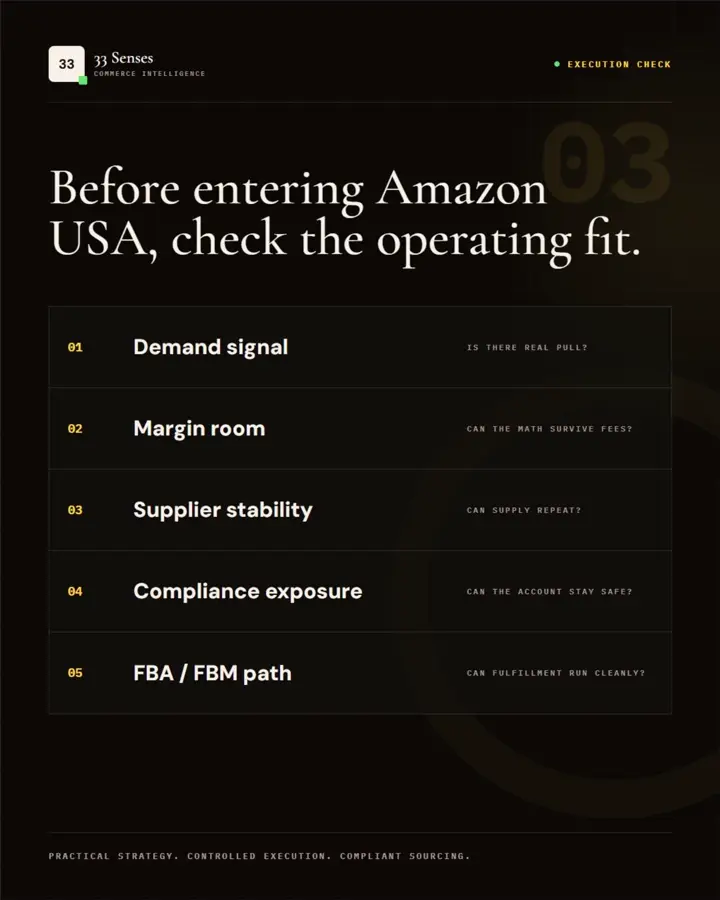
Swipe through this 7-slide framework from 33 Senses on why Amazon USA product selection should be evaluated through demand, sourcing, margins, compliance, and fulfillment execution.



Five execution checks before entering Amazon USA
Before choosing a product for Amazon USA, sellers and brands should evaluate five practical areas.
1. Demand signal
Demand should be studied beyond surface-level interest. A product needs consistent buyer activity, a clear use case, and enough market movement to justify inventory and operating effort.
For FMCG and personal care products, repeat demand can be especially important. These categories may offer recurring purchase behavior, but they still need careful category and compliance review.
2. Margin room
A product with demand can still fail if the margin is too thin.
Amazon referral fees, FBA fees, storage costs, advertising spend, shipping, packaging, returns, and currency movement can reduce profitability. Sellers should understand the real contribution margin before scaling inventory.
The goal is not just to sell. The goal is to sell with a margin structure that can survive normal marketplace pressure.
3. Supplier stability
Sourcing is one of the biggest execution risks in Amazon USA selling.
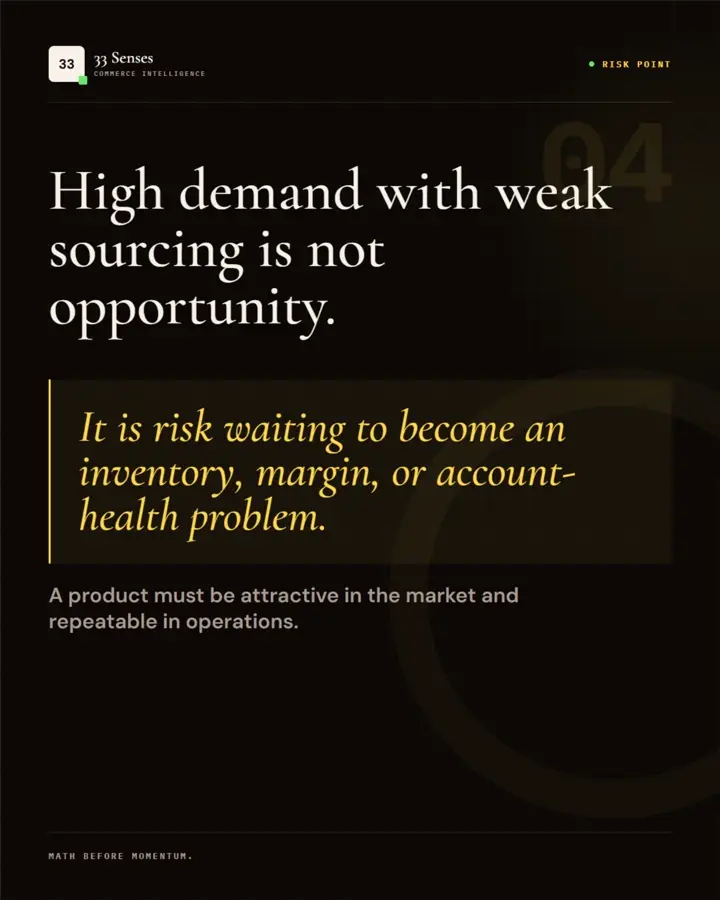
If the supplier cannot provide consistent quality, repeat availability, proper documentation, or stable pricing, the product becomes difficult to scale. A high-demand product with weak sourcing is not an opportunity. It is a future problem.
This is especially important for export-ready brands and suppliers entering Amazon USA for the first time.
4. Compliance exposure
Compliance should be checked before the product goes live.
Category rules, labeling, documentation, product claims, restricted ingredients, safety expectations, and marketplace policies can all affect listing stability and account health.
For personal care and FMCG products, compliance risk should be treated as part of product selection, not as a later step.
5. FBA / FBM execution path
Fulfillment planning should be clear from the beginning.
Some products may work better with FBA because of customer expectations and delivery speed. Others may require a more controlled FBM or hybrid approach due to storage, handling, seasonality, or inventory risk.
The product should fit the fulfillment model, not the other way around.
Why weak sourcing creates future problems
High demand often creates urgency. Sellers may feel pressure to move fast before competitors enter.
But if sourcing is unstable, speed can create risk.
Weak sourcing can lead to stockouts, inconsistent product quality, margin erosion, late replenishment, listing issues, poor reviews, and account-health problems.
That is why Amazon USA product evaluation should connect demand with operational repeatability.
In practical terms:
- Demand shows whether the market may want the product.
- Sourcing shows whether the seller can keep supplying it.
- Margin shows whether the business can survive.
- Compliance shows whether the account can stay safe.
- Fulfillment shows whether the customer experience can be delivered.
All five areas need to work together.
Why 33 Senses is focusing on FMCG and personal care
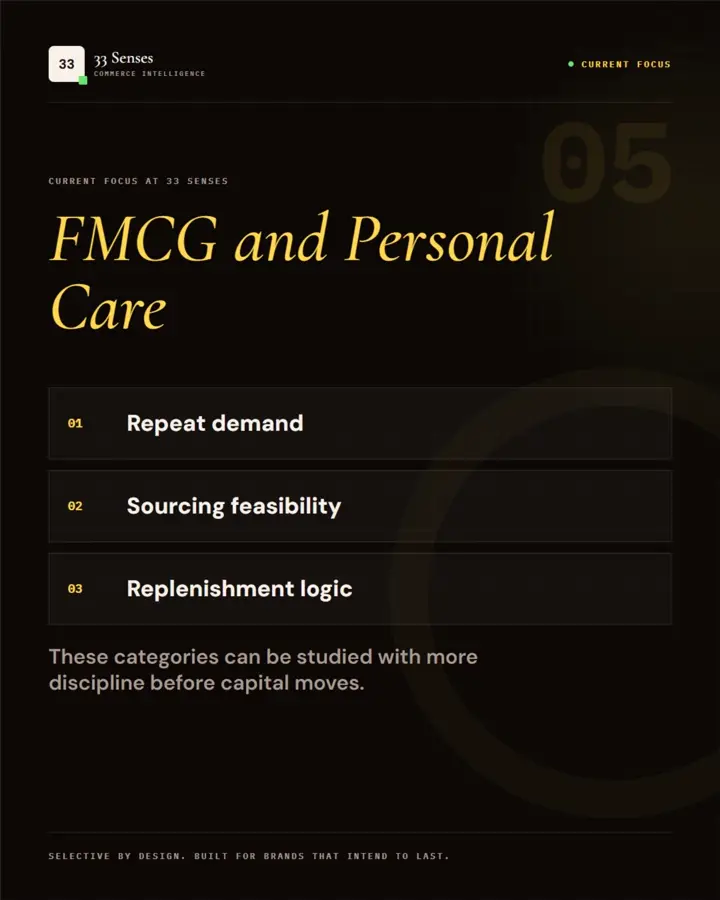
33 Senses is currently focused on FMCG and personal care opportunities because these categories can be studied through repeat demand, sourcing feasibility, replenishment logic, and operational discipline.
These products are not automatically easy. In fact, they often require more attention to compliance, packaging, documentation, and supplier reliability.
But when evaluated properly, they can help sellers and export-ready brands think more clearly about long-term Amazon USA execution.
A practical Amazon USA execution plan
A serious Amazon USA plan should include more than product research.
It should cover:
- Product and category evaluation
- Sourcing and documentation awareness
- Margin and fulfillment planning
- Listing readiness
- Compliance review
- Inventory and replenishment planning
- Ongoing marketplace execution
This is the difference between chasing products and building an operating path.
Final takeaway
Amazon USA growth looks attractive, but product demand alone is not enough.
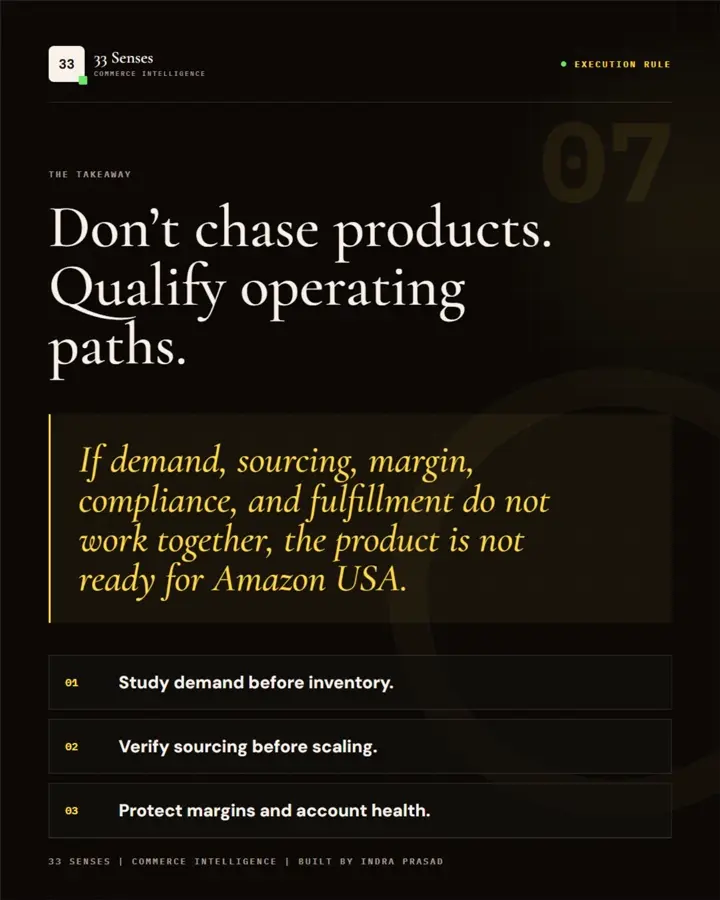
Before entering the market, sellers and brands should qualify the full operating path.
If demand, sourcing, margin, compliance, and fulfillment do not work together, the product is not ready for Amazon USA.
At 33 Senses, our focus is practical execution for Amazon sellers and export-ready brands. We believe marketplace growth should be practical before it becomes aggressive.
Frequently asked questions
- What is the most important factor in Amazon USA product selection?
- Demand is important, but it should not be the only factor. A product should also have workable margins, stable sourcing, manageable compliance risk, and a clear FBA or FBM execution path.
- Is high demand enough to launch a product on Amazon USA?
- No. High demand can be attractive, but weak sourcing, poor margins, or compliance issues can turn the product into a future operational problem.
- Why are FMCG and personal care products interesting for Amazon USA?
- FMCG and personal care products can have repeat demand and replenishment potential. However, they also require careful review of sourcing, documentation, labeling, claims, and compliance.
- Should sellers choose FBA or FBM for Amazon USA?
- It depends on the product. FBA can support faster delivery and customer trust, while FBM can provide more control in certain cases. The fulfillment model should match the product's cost, storage, handling, and demand pattern.
- How does 33 Senses support Amazon sellers and export-ready brands?
- 33 Senses focuses on practical Amazon USA execution, including product and category evaluation, sourcing feasibility, margin awareness, compliance risk, and operational planning.
Want a practical execution review for your Amazon USA plan?
We work with sellers, suppliers and export-ready brands on product evaluation, sourcing feasibility, margin and fulfillment planning, compliance review, and ongoing marketplace execution.